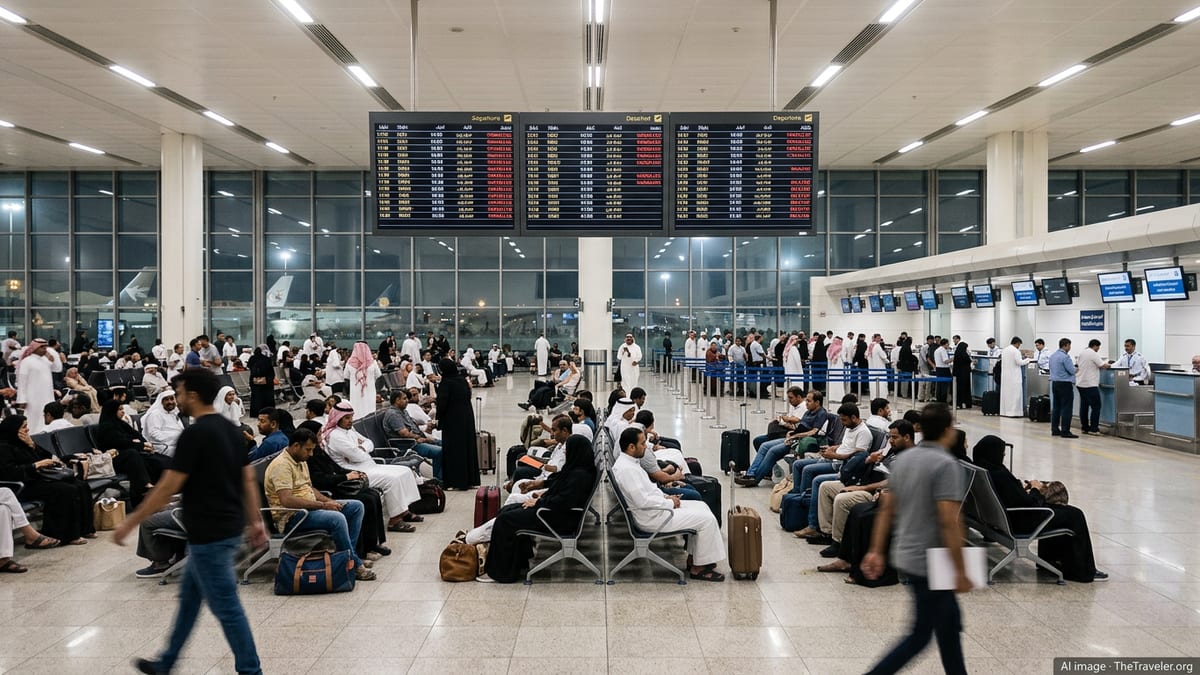
A missile strike attributed to Yemen’s Iran-backed Houthi group hit the passenger terminal at King Khalid International Airport in Riyadh on Saturday, October 10, 2026, killing at least 12 people and wounding 309 others in the deadliest attack on Saudi Arabia in more than a decade. The assault—the third on the capital’s main airport this week—suspended operations, diverted flights, and triggered strong condemnation along with vows of retaliation from the Saudi-led coalition.
Casualties and Immediate Impact
Saudi Arabia’s General Authority of Civil Aviation (GACA) reported that the dead included four Saudi citizens, two Bangladeshi nationals, and one person each from the United States, Egypt, Jordan, Syria, Palestine, and Sudan. Some of the 309 injured were in critical condition and were treated at multiple hospitals, with ambulances and helicopters transporting the wounded. Eyewitness accounts described chaos in the terminal, collapsing ceiling sections near departure gates, debris, and people fleeing. A regional official said the strike hit the complex housing Terminals 3 and 4 used for domestic flights. Operations were temporarily suspended pending damage assessments, and all flights were diverted from the airport serving a city of roughly 8 million people. Flight-tracking data showed hundreds of cancellations and delays. (BBC, CNN, Reuters)
The attack occurred without a prior alert from Saudi Arabia’s threat warning system. A Houthi media office post claimed the group had “shut down” the airport, and a senior Houthi official later attributed the strike to retaliation for Saudi actions in Yemen. Earlier in the week, the Houthis had claimed ballistic and cruise missile attacks on the same facility. (CNN)
Pattern of Escalating Attacks This Week
The Saturday strike followed a series of Houthi attacks targeting Saudi aviation infrastructure:
- On October 6–7, attacks on Abha International Airport and King Khalid Airport killed three people (including two women of Moroccan and Algerian nationality at Abha and a Sudanese national in Riyadh) and injured dozens.
- On Thursday, October 8, two attacks on Riyadh’s airport killed three Saudi nationals, including Saudia Captain Hamoud Ali Alkalthami, and damaged a Saudia aircraft parked on the ground (no passengers aboard). Smoke was reported, and debris from an interception damaged a kindergarten and medical complex in Riyadh. The Houthis claimed the strikes, stating they had targeted the airport with missiles and also struck sites in Najran and Khamis Mushait. (BBC, Al Jazeera, Reuters)
The Saudi-led coalition said it had intercepted several missiles and destroyed launch platforms and more than 80 Houthi military targets in Yemeni governorates including Saada, Hodeidah, Jawf, and Marib in response to the earlier strikes. A projectile was also reported near King Fahd International Airport in Dammam on Saturday. (Arab News)
Saudi and Coalition Response
Coalition spokesman Major General Turki al-Malki described the Saturday attack on a civilian passenger terminal—killing passengers and airport staff—as a “full-fledged war crime” and a “cowardly terrorist attack” under international humanitarian law. He stated that the Joint Forces Command would respond firmly. The coalition has repeatedly vowed that attacks on civilians will not go unpunished and has conducted intensive airstrikes on Houthi positions. (BBC, Arab News)
International Reactions
US President Donald Trump said the attack was “not acceptable” and indicated the United States “may” join Saudi strikes against the Houthis after reviewing the situation, noting he would speak with Crown Prince Mohammed bin Salman. US Secretary of State Marco Rubio confirmed an American citizen was among the dead and condemned the strikes as demonstrating “a blatant disregard for innocent civilian life.” UN Secretary-General António Guterres expressed deep shock, calling the attacks a violation of international law that must cease immediately. Condemnations also came from Egypt, Palestine, Qatar, and others. Western embassies, including those of the UK, US, Spain, and Canada, warned citizens against using the Riyadh airport. Pakistan’s Prime Minister Shehbaz Sharif reiterated support under the Makkah Joint Defence Agreement. (CNN, BBC)
Aviation Disruptions and Economic Context
Airlines including Lufthansa, Air India, Etihad, Kuwait Airways, and others canceled or suspended flights. The European Union Aviation Safety Agency expanded no-fly advisory zones, and OPSGROUP advised against operations over the kingdom due to risks of misidentification amid missile and interception activity. The Houthis have declared Saudi airspace a zone of military operations and warned airlines to avoid it (with limited exceptions). The timing coincides with preparations for major events in Riyadh, including energy congresses, raising concerns about disruptions to the kingdom’s push to become a global travel and business hub under Vision 2030. (Reuters, CNN)
Broader Conflict Context
The attacks mark a sharp escalation in the long-running Yemen civil war, which intensified after a 2022 ceasefire largely unraveled in July 2026 amid a wider regional conflict involving Iran. The Iran-aligned Houthis control much of northern Yemen and have targeted Saudi airports, oil facilities, and shipping in the Red Sea and Bab al-Mandab Strait. Recent Houthi advances on the Red Sea coast prompted a Saudi-backed counteroffensive (“Yemen’s Dawn”) by internationally recognized Yemeni government forces, with intense fighting around Taiz and the strategic strait. Saudi Arabia has conducted extensive airstrikes, while the Houthis frame their cross-border attacks as retaliation for Saudi support of the Yemeni government, blockade effects, and strikes on Yemeni civilian infrastructure. The war has caused massive humanitarian suffering and displacement. Saudi Arabia has sought support from partners including Pakistan and Turkey under mutual defense arrangements. (Reuters, BBC, CNN)
Strategic Implications
The repeated penetration of Saudi air defenses against civilian targets exposes vulnerabilities as Riyadh balances military pressure on the Houthis with its ambitions as a global hub. The attacks threaten commercial aviation safety, oil-related gatherings, and regional stability, while raising the prospect of deeper US involvement under the Trump administration. Independent verification of battlefield claims remains limited, and both sides continue exchanging strikes. The situation continues to evolve rapidly.