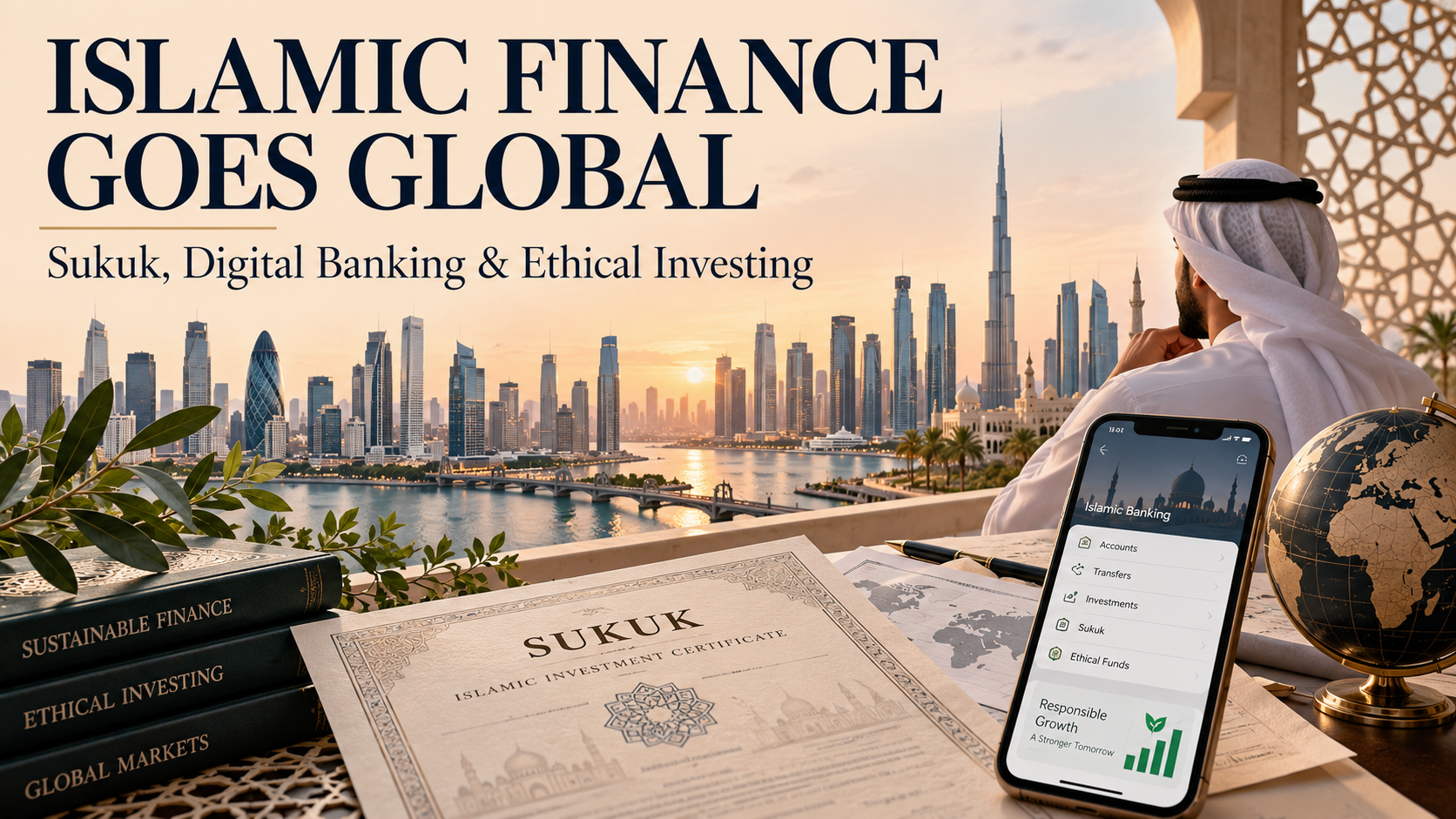
Islamic Finance Goes Global: Sukuk, Digital Banking, and Ethical Investing takes center stage in 2026 amid uneven global growth, heightened sensitivity to borrowing costs, and a market where investors must separate narrative hype from true asset value. Rather than promising guaranteed returns, this guide delivers a grounded framework focused on research methodologies and risk management. This approach aligns directly with the IMF’s October 2026 outlook—projecting 3.1% global growth and 4.7% inflation—and reflects IMF financial-stability warnings that underlying structural risks persist despite surface-level market resilience.
Key takeaways
- Match each investment decision to its time horizon, currency and ability to withstand losses.
- Separate observable earnings or contractual cash flows from optimistic forecasts.
- Compare diversification, fees, taxes, liquidity and regulatory restrictions before committing capital.
- Track primary institutional evidence and update assumptions when conditions change.
- Readers in Pakistan should consider rupee exposure and availability of regulated investment channels.
Why this matters now
The central question behind Islamic finance 2026 global is not merely what may happen next. It is which economic mechanisms could change cash flow, purchasing power or risk. The Bank for International Settlements’ 2026 review describes an economy supported by technological investment but constrained by geopolitical and fiscal pressures. A robust financial plan must therefore survive both a favourable and an adverse scenario.
Islamic finance is not a single investment product
Islamic finance refers to financial arrangements designed to comply with Shariah principles, including restrictions on interest and certain forms of uncertainty or prohibited economic activity. Deposits, home financing, investment funds, takaful and sukuk have different risks. Investors should examine the actual contract and governance opinion, not assume every product with an Islamic label is equivalent. See the primary institutional research.
For practical analysis, separate the baseline, the upside case and the downside case. Document the specific development that would change your assessment. Assess timing: a promising long-term theme may still be inappropriate for cash needed within twelve months.
Sukuk: assess underlying cash flows
Sukuk structures give investors rights connected to underlying assets, services or enterprise cash flows, subject to the relevant contract. Some are economically exposed to an obligor’s creditworthiness and refinancing conditions much like other fixed-income instruments. Review asset ownership, payment waterfall, legal enforceability, currency and liquidity. A Shariah-compliant structure does not eliminate loss risk. See the primary institutional research.
For practical analysis, separate the baseline, the upside case and the downside case. Document the specific development that would change your assessment. Assess timing: a promising long-term theme may still be inappropriate for cash needed within twelve months.
Digital Islamic banking: convenience and controls
Mobile onboarding and digital payments expand access, but customers need clear fee schedules, dispute resolution and protection against fraud. Digital banks must still address cybersecurity, operational continuity, anti-money-laundering requirements and consumer protections. Regulation varies by country and by the legal form of the provider. See the primary institutional research.
For practical analysis, separate the baseline, the upside case and the downside case. Document the specific development that would change your assessment. Assess timing: a promising long-term theme may still be inappropriate for cash needed within twelve months.
Ethical investing beyond sector screens
Shariah screening typically combines business-activity exclusions with financial ratios and governance requirements. Methodologies differ, creating different holdings across funds. Compare expense ratios, concentration, purification disclosures where relevant and the qualification of Shariah advisers. Ethical objectives and financial return expectations should be evaluated separately.
For practical analysis, separate the baseline, the upside case and the downside case. Document the specific development that would change your assessment. Assess timing: a promising long-term theme may still be inappropriate for cash needed within twelve months.
Pakistan and international opportunity
Pakistan’s Islamic banking market can benefit from better digital distribution and transparent financial education, while international investors may examine sukuk and Islamic equity funds. However, cross-border access, tax, currency, listing and custody conditions may limit practical choices. Verify current Pakistani requirements with the State Bank and securities regulator before transacting. See the primary institutional research.
For practical analysis, separate the baseline, the upside case and the downside case. Document the specific development that would change your assessment. Assess timing: a promising long-term theme may still be inappropriate for cash needed within twelve months.
Comparison and decision framework
| Question | Stronger evidence | Warning sign |
|---|---|---|
| What drives returns? | Audited cash flows, clear contract or transparent index | Undefined or projected returns |
| What can go wrong? | Explicit scenario and downside analysis | Claims of guaranteed gains |
| Is it affordable to hold? | Low transparent fees and adequate liquidity | Leverage, costly spreads or lockups |
| Is access legitimate? | Appropriate licensing and clear legal rights | Unverified brokers or custody |
| Is the exposure diversified? | Multiple independent sources of return | One company, sector or currency |
What it means for Pakistani savers and investors
A Pakistani reader faces both international investment risk and local purchasing-power risk. For example, a foreign asset can rise in US-dollar terms while the rupee conversion and transaction costs alter the realized local outcome. The opposite can also occur. Record the starting exchange rate, applicable taxes, custody charges and capital-transfer restrictions, and confirm current requirements with the State Bank of Pakistan and the relevant securities regulator. Overseas access should not be assumed universally available.
An emergency reserve, expensive consumer debt and near-term family obligations deserve attention before any speculative allocation. A portfolio that cannot meet a sudden cash requirement may force sales at the worst moment. The objective is not to remove risk—impossible in markets—but to choose risks that fit the investor’s actual liabilities.
Risks, limitations and uncertainty
Institutional forecasts are conditional and can change after policy decisions, commodity shocks, conflict escalation or unexpectedly weak earnings. Historic correlations are not binding promises about future asset performance. The analysis does not provide live stock prices, current investment product quotes, real-time exchange rates or individualized tax advice. Prices, regulations and product eligibility should be checked on the transaction date.
Frequently asked questions
Is this a guaranteed investment opportunity?
No. Every financial asset or strategy involves uncertainty. The existence of a popular investment theme is not evidence that an individual security is fairly priced.
What should beginners examine first?
Understand the product, the financial loss you could tolerate, fees and liquidity. Verify the provider and decide whether the money may be needed soon.
How do interest rates affect the analysis?
They influence financing costs, discount rates, exchange rates and demand. The effect differs by sector, maturity and business balance sheet.
Can Pakistani residents invest in foreign markets?
Access depends on current foreign-exchange, banking, brokerage, securities and tax rules, and on the investor’s individual circumstances. Check current regulations and regulated providers rather than assuming access.
How often should this analysis be refreshed?
Review institutional economic releases monthly and re-evaluate immediately after material earnings, regulatory or policy changes. Avoid reacting mechanically to every daily market movement.
Is diversification enough to prevent losses?
No. Diversification may reduce company-specific risk but cannot eliminate broad market, currency, inflation or systemic risks.
Conclusion
Sound financial decisions begin with verifiable evidence, reasonable valuation, awareness of uncertainty and a plan that survives adverse outcomes. Readers should compare multiple independent sources and avoid letting a compelling headline substitute for due diligence.