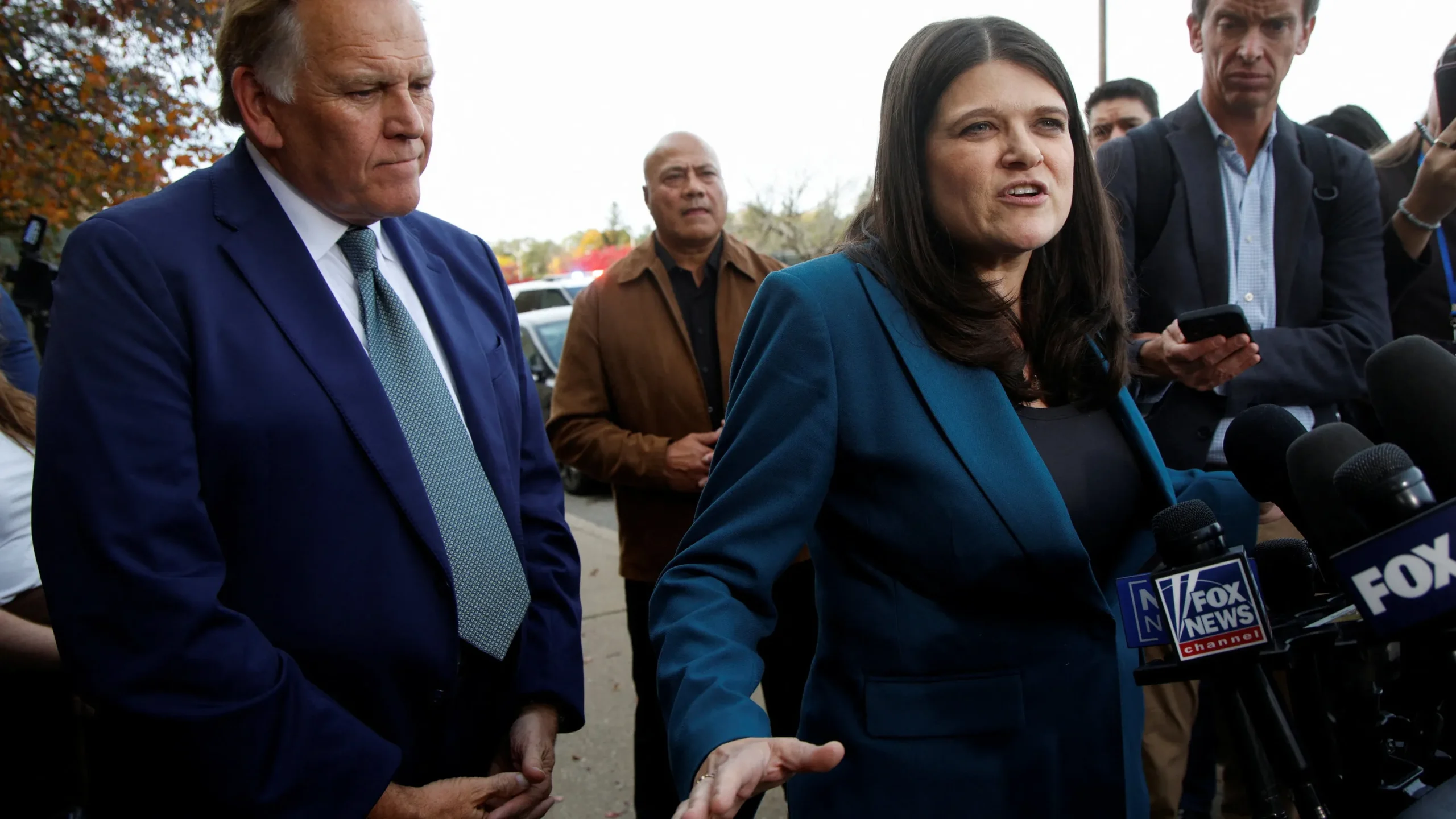
A defeated Democrat’s decision to back Republican Mike Rogers has handed Donald Trump a remarkable closing-weekend talking point. But with millions of Michigan voters already committed and Abdul El-Sayed ahead in the latest polls, the harder question is whether the rupture will change votes—or merely expose divisions that were there all along.
Two days before Michigan chooses its next United States senator, a Democratic congresswoman did something that would once have been almost unimaginable in a race this consequential: she endorsed the Republican.
Haley Stevens, who narrowly lost the Democratic primary to Abdul El-Sayed in August, appeared alongside Mike Rogers at Detroit’s Perfecting Church on Sunday, November 1. She then announced that Rogers—not her party’s nominee—deserved a Senate seat that Democrats are fighting to retain. The announcement shattered a planned show of Democratic unity and prompted an immediate backlash from party leaders and Stevens’s own staff. The Associated Press documented the church appearances and the resulting resignations.
President Donald Trump promptly seized the opening. Speaking at a campaign rally in Iowa, he praised Stevens and said he would welcome her into the Republican Party. Yet Stevens has described herself as a proud Democrat and characterized her support for Rogers as a decision about this particular race, rather than a wholesale change of party. TIME reported Trump’s invitation and Stevens’s insistence that she remains a Democrat.
The spectacle has dominated the last hours of one of the nation’s most closely watched contests. Its electoral significance, however, is less straightforward than its political symbolism. An endorsement cannot be counted as a block of transferable votes. And the people most likely to hear about it are not necessarily the people still deciding how to vote.
What happened—and why the timing matters
Stevens was expected to join El-Sayed and prominent Democrats for a Detroit-area church event designed to project unity and encourage turnout. The appearance collapsed amid an escalating dispute. Representative Debbie Dingell said she, rather than El-Sayed, had asked Stevens not to attend because the tensions had become distracting. Stevens subsequently joined Rogers at another church service and publicly endorsed him. That distinction matters: the competing accounts should not be flattened into a claim that El-Sayed personally expelled Stevens from his campaign. AP’s on-the-ground account and The Washington Post’s reconstruction describe an increasingly chaotic attempt to arrange the appearance.
The endorsement was not the culmination of a publicly declared party switch. As recently as the preceding week, Stevens had said she wanted El-Sayed to win, even as her fiancé publicly backed Rogers. Staff members who had not expected the reversal were reportedly blindsided. Her longtime chief of staff, Justin German, resigned; other aides also left. Senate Democratic leader Chuck Schumer condemned the decision as a betrayal, while Michigan Democratic chair Curtis Hertel said Stevens was not a current member of the state party and would not be in the future. Reuters and AP reported the reactions.
For Republicans, the picture of a Democratic congresswoman standing with Rogers was a political gift: it gave the party an apparent validator from the other side of the aisle. For Democrats, it was an unwelcome diversion from the prices, healthcare costs and economic insecurity that El-Sayed had made central to his closing message.
The roots of the rupture: Israel, an outside advertisement and a bitter primary
The personal conflict makes little sense without the August primary. El-Sayed, a former public health official running as a progressive, defeated Stevens, a more establishment-aligned congresswoman, by less than a percentage point. The primary attracted extraordinary outside spending and exposed disagreements not only about candidates but also about who should shape Democratic policy. The Washington Post reported that El-Sayed prevailed despite the spending advantage enjoyed by his opponent; Axios reported more than $60 million in outside spending in the primary.
Israel became a defining fault line. Stevens has been a strong supporter of Israel. El-Sayed has sharply criticized Israel’s conduct in Gaza and U.S. military support for it. An outside group supporting El-Sayed, Rebellion PAC, released an advertisement that tied U.S. assistance to Israel to Americans’ struggle with grocery prices. Stevens described the advertisement as antisemitic and demanded that El-Sayed denounce it. El-Sayed said his campaign neither produced the advertisement nor agreed with its contents, but resisted being drawn into a continuing dispute over material made by an independent group. AP and Al Jazeera’s explainer set out the competing positions.
There are two distinctions that serious coverage must preserve. Criticism of an Israeli government’s policies is not, on its own, evidence of hostility to Jews. Equally, concerns raised by Jewish voters about antisemitism deserve attention on their merits rather than being dismissed as a political device. The question in this particular controversy is what was said, who said it, and whether a candidate should be held responsible for messaging created independently of his campaign.
Stevens also criticised El-Sayed’s association with political streamer Hasan Piker, whose past comments about Israel have drawn controversy. El-Sayed, a Muslim American born in Michigan, has meanwhile faced attacks questioning his loyalty to the United States. Reuters described accusations portraying him as a terrorist sympathiser as baseless. These are distinct issues, and neither a candidate’s faith nor an ally’s rhetoric should substitute for scrutiny of the candidate’s own statements and record. Reuters’ November 2 reporting provides the relevant context.
The result is a collision of legitimate policy disagreements, deeply felt communal concerns, campaign messaging and personal distrust. By Election Day, the dispute had become a test of whether an ideologically diverse party could accept its primary result and compete in a general election.
The polling tells a calmer story than the headlines
The central electoral question is whether Stevens’s endorsement can rescue Rogers—or whether the scale of the drama exaggerates its likely effect. The latest publicly available surveys favor El-Sayed, although they differ substantially in their estimates.
| Poll and field dates | El-Sayed | Rogers | Democratic lead |
|---|---|---|---|
| New York Times/Siena, Oct. 23–Nov. 1 | 53% | 42% | 11 points |
| Mitchell Research for CBS Detroit, Oct. 26–27 | 51% | 44% | 7 points |
| YouGov, Oct. 26–29 | 51% | 47% | 4 points |
Sources: Siena Research Institute’s November 1 release, CBS Detroit’s October 28 report, and RealClearPolitics ‘ survey tracker.
The Siena survey’s reported Michigan sampling margin of error was approximately 3.8 percentage points. But sampling error is not the only uncertainty: turnout assumptions, survey modes, undecided voters and possible systematic polling errors also matter. A lead in a poll is not a certified election result.
More importantly, these surveys do not measure the effect of Stevens’s endorsement. The Siena poll was conducted over several days ending November 1, so most of its interviews took place before the announcement. The two other surveys were completed beforehand. It would be statistically unjustified to credit or blame Stevens for any of those margins.
Nor does the close primary prove that Rogers can collect Stevens’s supporters one-for-one. A voter who preferred Stevens to El-Sayed within the Democratic primary may still prefer El-Sayed to a Republican in November. Some may abstain, some may cross party lines, and others may decide that the controversy reinforces their support for the nominee. The proportions are unknown.
More than 1.8 million ballots were already cast
Timing creates an additional obstacle for anyone trying to translate the endorsement into votes. According to Associated Press reporting, more than 1.8 million Michiganders had voted by Friday, October 30—before Stevens appeared with Rogers. Earlier, the Michigan Secretary of State reported that 1.39 million ballots had been cast as of October 27.
Those voters had already made their choices. A dramatic Sunday announcement could influence remaining voters, media coverage, donor behaviour, and turnout operations; it could not retroactively change ballots already cast. That does not render the endorsement irrelevant, especially in a close contest, but it narrows the window through which it can operate.
There are at least three plausible political effects. It might persuade a limited number of Democrats or independents who trusted Stevens to back Rogers. It might discourage some Democratic voters from turning out. Or the backlash could energise El-Sayed’s supporters, making the endorsement counterproductive for Republicans. These are competing possibilities, not findings established by current polling.
Indeed, El-Sayed’s campaign said it raised $1.2 million in four hours following Stevens’s announcement, according to Reuters. That is a campaign-reported figure, not independently verified fundraising totals, and donations are not votes. Still, it illustrates how an apparent setback can produce a rapid mobilisation response.
Why Trump welcomed Stevens—and why her endorsement matters nationally.
For Trump, the endorsement serves a purpose larger than a single Senate seat. It allows him to present the Republican nominee as acceptable to Democrats who regard El-Sayed as too far to the left or too confrontational on Israel. For Stevens, the endorsement seems to reflect a conviction that the policy and rhetorical disagreements have become disqualifying, even at the expense of her party’s electoral strategy. Those are interpretations of their public positions, not demonstrated private motives.
Trump’s invitation to Stevens to join the GOP sharpened the paradox. She has said she remains a Democrat. A cross-party endorsement, however conspicuous, is not the same as registering with another party or becoming a Republican lawmaker. TIME’s report and The Guardian’s November 2 coverage document the contrasting statements.
The Senate arithmetic explains the ferocity of the response. Republicans hold a 53–47 majority. Democrats need a net gain of four seats to secure control; if the parties split the chamber 50–50, Republican Vice President JD Vance would hold the tie-breaking vote. Michigan is presently represented by retiring Democrat Gary Peters, so an El-Sayed victory would protect an existing Democratic seat rather than add a pickup. A Rogers victory would make the opposition party’s path to a majority harder. Reuters’ Senate battleground analysis details the national balance.
In practical terms, the result will help decide which party controls Senate committees, confirmation proceedings and the chamber’s legislative agenda during the remainder of Trump’s term. That is why party leaders reacted to Stevens not simply as a dissenter but as someone potentially affecting institutional power.
The policy contest Michigan voters were supposed to be hearing
The personalities have obscured meaningful differences between the two men actually on the ballot. El-Sayed is a former Detroit and Wayne County public health official campaigning on a progressive economic agenda. Rogers is a former FBI agent, seven-term congressman and House Intelligence Committee chair who narrowly lost Michigan’s other Senate race to Democrat Elissa Slotkin in 2024. Axios’s candidate guide identifies their backgrounds and proposals.
| Issue | Abdul El-Sayed (Democrat) | Mike Rogers (Republican) |
|---|---|---|
| Healthcare | Supports Medicare for All and an expanded public role in coverage | Emphasises price transparency and market-oriented cost measures |
| Industry and trade | Supports targeted tariffs and protection for manufacturing workers | Defends some tariffs but says the tariff dispute with Canada should end |
| Israel | Criticizes U.S. military support and advocates an arms embargo | Supports continued U.S. military assistance to Israel |
| Iran war | Calls for ending the war | Has more recently called for an end to the war |
These are concise summaries, not complete platforms. Sources: Axios’s issue-by-issue comparison, CBS Detroit’s debate coverage, and Detroit-area reporting on tariffs.
The actual electoral argument touches paychecks, auto-sector jobs, medical bills, housing costs and Michigan’s relationship with Canada. In an industrial state vulnerable to shifts in trade policy, those questions may matter far more to persuadable voters than the political identities of campaign surrogates.
Michigan’s coalition problem is bigger than one congresswoman
The state can produce opposite outcomes in the same election cycle. Trump carried Michigan in 2024, while voters also elected Democrat Elissa Slotkin to the Senate, defeating Rogers. That experience undercuts the idea that presidential party preference automatically translates into a Senate choice. The Washington Post’s account of the 2026 primary recounts Rogers’s earlier loss.
The more revealing question is which coalition turns out on November 3. El-Sayed needs progressive voters who powered his primary victory but also Democrats who preferred Stevens, independents, and voters drawn primarily by his economic message. Rogers needs a strong Republican vote while finding enough crossover support to beat a Democrat in a state that continues to elect candidates from both parties.
Jewish, Muslim, Arab American and Black voters have all figured prominently in the political discussion. None is a monolithic voting bloc. Individuals within each community disagree over Israel, domestic policy, public safety and party loyalty. AP’s Detroit reporting describes competing concerns about voter enthusiasm in the region. The sounder analytical approach is to watch participation and actual returns—not assume that a public dispute tells us how an entire community will vote.
Stevens’s surprise endorsement could become a defining symbol of the party’s internal fractures. But one symbol cannot tell us how many votes changed hands. Its ultimate significance will be measured against county-level turnout, suburban margins and the eventual statewide result.
Three ways Election Day could change the interpretation
If El-Sayed wins comfortably, the most plausible reading will be that Democratic anger, issue preferences and the existing polling advantage outweighed the endorsement. It would not prove that intraparty disagreement is harmless; it would show only that this rupture did not prevent victory.
If El-Sayed wins narrowly, Democrats may argue that the last-minute disunity imposed an avoidable risk. Even then, attributing a specific number of lost votes to Stevens would require evidence unavailable from election returns alone.
If Rogers wins, Republicans will almost certainly point to the endorsement as evidence of a successful cross-party appeal. But a Rogers victory could also be explained by differences in turnout, late undecided voters, advertising, the economy or polling error. A compelling post-election analysis must examine these alternatives rather than assign causation to the most dramatic headline.
There is a longer-term consequence as well. The disagreement over Israel, progressive activism and party loyalty will not vanish when the polls close. The 2026 Michigan contest is a warning that ideological diversity can be an electoral strength only when parties find ways to compete after bruising primaries. That challenge will recur nationally, particularly as the next presidential cycle approaches.
The verdict: a historic break, not yet an electoral earthquake
Haley Stevens’s decision gave Mike Rogers a powerful image and Donald Trump an irresistible campaign line. It exposed a genuine problem for a Democratic Party struggling to reconcile its positions on Israel, foreign policy and its own emerging progressive wing. The scale of the backlash, including staff resignations and party denunciations, shows how extraordinary the break was.
But the available evidence does not show that the endorsement has reversed the Michigan Senate race. The strongest late polls still favour Abdul El-Sayed. Much of the electorate had already voted. And the candidate targeted by the endorsement says the resulting attention has helped him raise money.
The distinction between political drama and electoral consequence is the story’s essential test. On November 3, Michigan voters—not a former primary rival, and not a presidential invitation to switch parties—will decide which of these competing futures goes to Washington.
Frequently asked questions
Why did Haley Stevens endorse Mike Rogers?
Stevens cited deep disagreements with Abdul El-Sayed over rhetoric surrounding Israel, an independent group’s advertisement, and his associations with controversial political figures. The immediate dispute also involved a cancelled Democratic unity appearance. She said she remained a Democrat despite backing the Republican nominee. AP.
Did Haley Stevens officially join the Republican Party?
No party switch was established in the reporting reviewed as of November 2. Trump invited her to join Republicans, but Stevens said she remained a Democrat. TIME.
Who is leading the Michigan Senate race?
Abdul El-Sayed led Mike Rogers 53% to 42% in the New York Times/Siena poll released November 1. Other recent surveys also placed El-Sayed ahead, with smaller margins. These surveys were not designed to isolate the effect of the November 1 endorsement. Siena Research Institute.
When is Michigan’s 2026 Senate election?
Tuesday, November 3, 2026. The Michigan Secretary of State provides current voting instructions and official election information.
Why does this Senate seat matter?
It is an open seat currently held by retiring Democratic Senator Gary Peters. Democrats need to retain it while pursuing gains elsewhere to overcome the Republicans’ 53–47 Senate majority. Reuters.