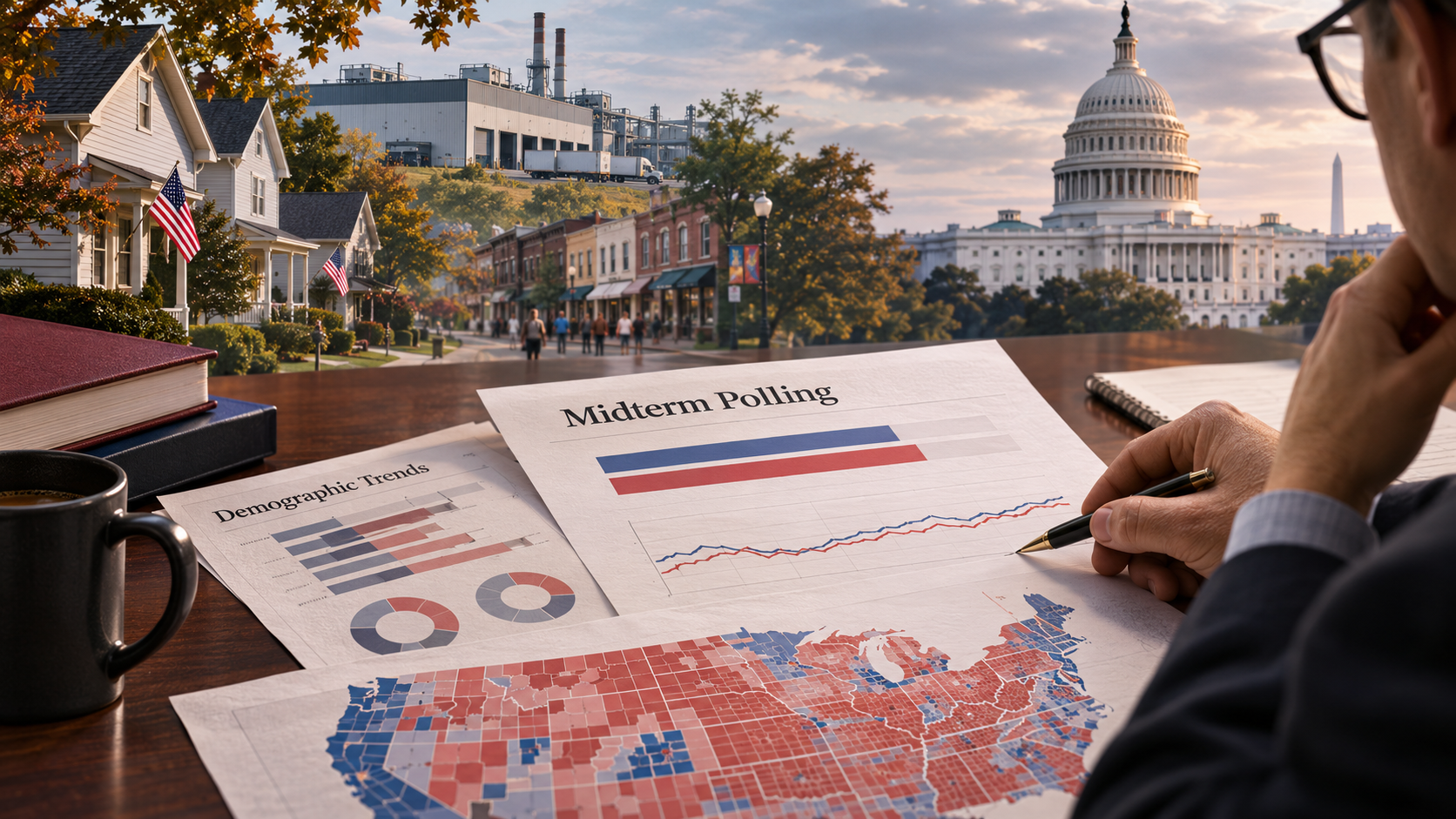
Every two years, Washington falls into the same ritual: obsessively tracking the national generic congressional ballot. As the 2026 midterm elections near, newsrooms and cable pundits once again treat minor fluctuations in top-line figures as seismic indicators of the national mood.
Yet, to understand the 2026 midterm landscape is to realize that the national popular margin has never mattered less.
While top-line aggregators point to shifting national averages, the true mechanics of this election are playing out across a remarkably narrow band of highly localized, structurally peculiar battlegrounds. The traditional narrative—that midterms are simply a blunt, binary referendum on the sitting president—is giving way to a more fragmented reality. Voters in 2026 are responding to a complex matrix of persistent inflationary pressures, localised candidate dynamics, and a profound institutional fatigue that transcends traditional party allegiances.
The Structural Traps of the Modern House
In the House of Representatives, where forecasters project high-stakes shifts, the real story is not national momentum, but the hyper-efficiency of modern gerrymandering and geographic sorting.
Historically, midterm cycles produced broad legislative waves. The “midterm curse”—the empirical reality that the president’s party almost invariably loses legislative seats—swept away dozens of marginal districts in cycles like 1994, 2010, and 2018. However, following the post-2020 redistricting cycle, the pool of genuinely competitive House seats has shrunk to a historically small figure.
Out of 435 congressional districts, fewer than 35 are decided by margins within five percentage points. As a result, the national generic ballot acts as an imperfect mirror. A two-point swing nationally does not produce a proportional shift in legislative power; instead, majorities now hinge entirely on a handful of suburban enclaves in states like New York, California, Virginia, and Pennsylvania.
In these suburban corridors, voter behaviour is defying classic mid-term trends. Rather than voting strictly on national ideological party lines, suburban voters are demonstrating an increasingly transactional relationship with both major political parties. The party that secures the House majority in 2026 will not be the one with the loudest national rallying cry, but the one that offers the most pragmatic answers to cost-of-living concerns, public safety, and governance stability.
The Senate’s Counter-Cyclical Reality
While the House remains a battle over suburban micro-climates, the Senate landscape presents an entirely different structural paradox.
Because Senate elections operate on staggered six-year cycles, the map itself often exerts far more influence over the outcome than the overarching national mood. In 2026, the Senate map places several high-profile seats in play across regions undergoing rapid demographic and political evolution.
Consider the dynamics in the Sun Belt and the rust-belt Midwest:
- The Sun Belt Realignment: In states like Texas, shifting urban-suburban margins continue to challenge long-held electoral baselines. While national observers often misread these shifts as sudden political inversions, local trends show a gradual, multi-cycle realignment driven by corporate migration, demographic shifts, and evolving suburban voting patterns.
- Midwestern Working-Class Dynamics: Conversely, in states like Ohio, candidate quality and localised economic identity frequently override national party brands. Voters who may favour one party at the presidential level have repeatedly shown a willingness to split their tickets for entrenched, high-profile statewide figures who speak directly to regional industrial and agricultural priorities.
This divergence between House and Senate dynamics creates a distinct possibility for 2026: a split outcome where legislative power is divided, further deepening the institutional friction that defines modern governance.
Beyond the Horse Race: The Governance Imperative
Focusing exclusively on electoral odds obscures the broader issue facing the electorate in 2026: the functional consequences of divided government in an era of hyper-polarisation.
Regardless of which party emerges with narrow majorities on November 3, the structural reality of the next Congress will be characterised by razor-thin margins. In a deeply divided legislature, governing becomes an exercise in crisis management rather than sweeping policy implementation. Narrow majorities empower factional caucuses, making basic legislative duties—such as passing appropriations bills or addressing national debt ceilings—recurring points of high-stakes political brinkmanship.
Furthermore, the 2026 midterms will set the immediate baseline for the 2028 presidential contest. A sweeping victory by the opposition party would likely trigger an era of aggressive oversight and legislative gridlock. Conversely, a defensive hold by the governing party would be interpreted as a mandate to push forward with contentious executive and legislative priorities.
Conclusion: The New Midterm Metric
As voters prepare to cast their ballots, media coverage must move past the simplistic framing of national wave elections. The 2026 midterms are not a single national story but a mosaic of localized contests defined by structural geography, candidate execution, and economic realism.
Understanding this election requires looking beyond aggregate polling averages and examining the quiet, structural shifts reshaping the American electorate. The party that successfully navigates this nuanced terrain will win more than just a temporary legislative majority—it will define the trajectory of American politics for the remainder of the decade.