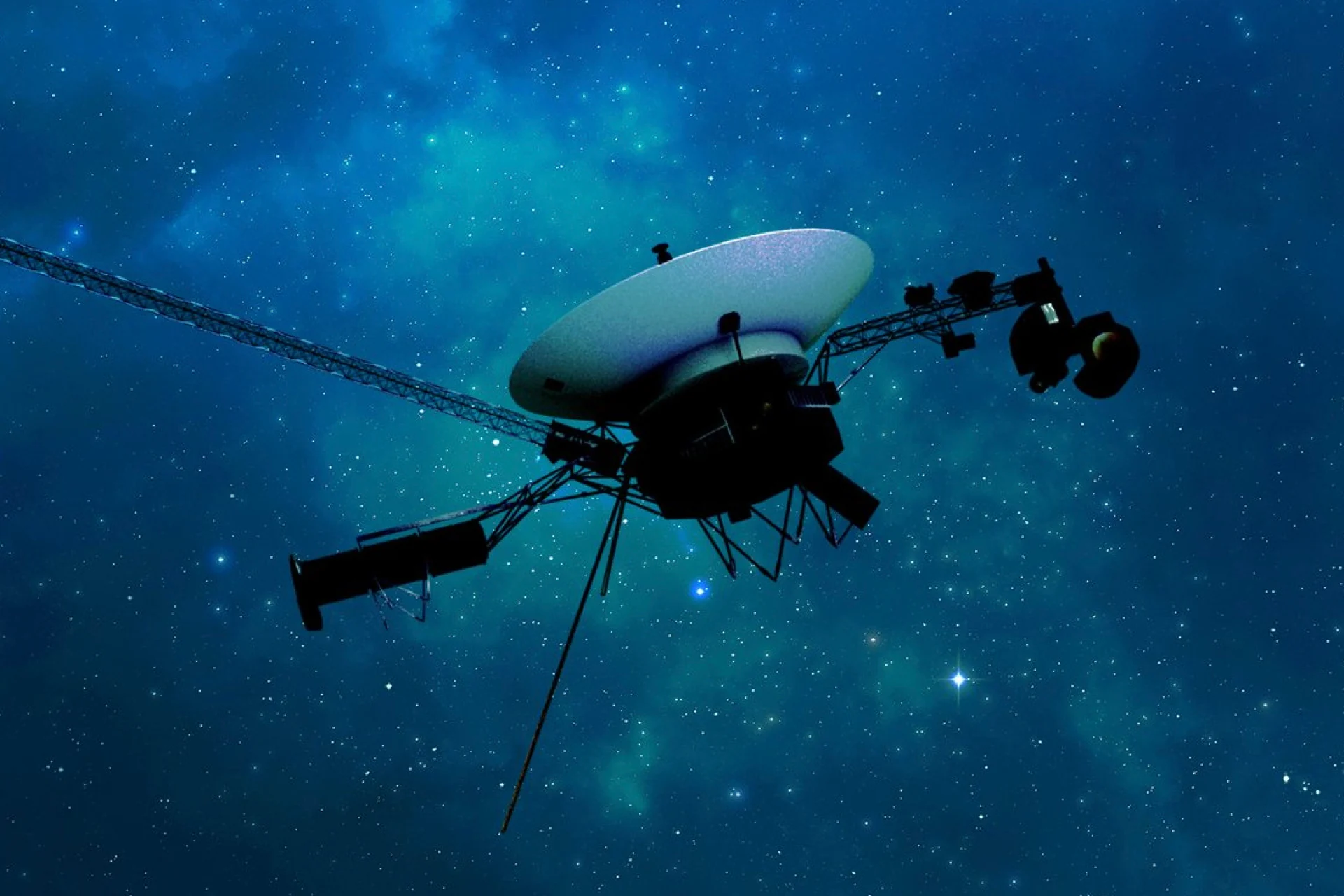
NASA’s predicted date is a future milestone, not an achievement already reached. Distance and communication delays change as Earth and the spacecraft move.
Quick answer: NASA projects that Voyager 1 will reach one light-day from Earth at 2:16:07 a.m. Pacific Standard Time on Wednesday, November 18, 2026 (5:16:07 a.m. Eastern). The distance is approximately 16.094 billion miles, or 25.902 billion kilometers. At that range, a radio message takes about 24 hours to travel one way between Earth and the probe. NASA’s live Voyager tracker gives the prediction.
A milestone defined by light, not a spacecraft speed record
The phrase one light-day can sound as though Voyager 1 has traveled through space for just a day. In reality the spacecraft launched in September 1977, made landmark encounters with Jupiter and Saturn, crossed into interstellar space in 2012 and has spent nearly half a century moving away from Earth. One light-day is a distance, the distance light travels through a vacuum in 24 hours, not the age of the spacecraft or its travel time.
That distinction is the key to understanding the announcement. Light travels about 186,000 miles a second. Human-built spacecraft travel many orders of magnitude more slowly. Voyager’s achievement is therefore not that it suddenly accelerated to anything like light speed; it is that its steady outward journey has lasted long enough to place it at a separation equal to a full day’s travel for light itself.
NASA’s detailed explainer says Voyager 1 will have taken 49 years, two months and 11 days from launch to reach the mark. That is an exceptional demonstration of durability, precise navigation and long-lived power engineering, rather than an exotic new propulsion method.
Exactly when and how far?
| Measurement | NASA’s predicted milestone |
|---|---|
| Date | Wednesday, November 18, 2026 |
| Pacific time | 2:16:07 a.m. PST |
| Eastern time | 5:16:07 a.m. EST |
| Distance from Earth | About 16.094 billion miles |
| Distance in metric units | About 25.902 billion kilometers |
| One-way radio time | Approximately 24 hours |
| A reply’s round trip | Approximately 48 hours, before command-processing delays |
The time and figures come from the NASA mission-status page. The date may be described in newsrooms in UTC or other time zones, but any conversion should use the same instant. Do not equate the number of hours on a public countdown with an immutable live reading, because the countdown is updated and the predicted range is based on relative Earth-spacecraft geometry.
There is another subtlety. Some science articles quote Voyager’s distance from the Sun, while NASA’s light-day announcement uses its distance from Earth. These are not identical quantities. Earth revolves around the Sun, so its position changes during the year. A reader comparing two websites may see slightly different mileage without either being wrong. The stated reference point matters as much as the unit.
What will happen to Voyager 1 on November 18?
As far as the spacecraft itself is concerned, essentially nothing sudden. There is no barrier, orbit, shock wave or planetary border at a distance defined by one day’s travel of light. NASA emphasizes that the instrument and environment will not change just because the mathematical separation crosses that round number.
Voyager 1 will continue through interstellar space on its existing trajectory, subject to normal operations, available power and communication constraints. The achievement is a human measure of scale: it takes radio waves a day to bridge the gap from Earth and another day for a response. NASA’s October 29 engineering update describes the implications for mission controllers.
Imagine a flight controller noticing a minor discrepancy in telemetry and sending a diagnostic instruction. At one light-day, the command does not arrive until about a day later. The return signal, even if sent immediately, takes another day. Before any operator can see the effect of a correction, roughly two Earth days can pass. Multiple rounds of troubleshooting can therefore stretch into many days even when engineers and equipment work perfectly.
Why Voyager 1 matters scientifically
Voyager 1 was built for close-up studies of the outer planets, but its extended mission expanded the scientific questions. The spacecraft’s Jupiter and Saturn encounters transformed planetary science, including the study of moons, rings and magnetospheres. Later measurements beyond the heliopause offered direct information about conditions in the local interstellar environment—the space outside the region dominated by the Sun’s solar wind.
NASA’s Voyager mission overview identifies Voyager 1 and Voyager 2 as the only spacecraft to have operated beyond the heliosphere. They entered interstellar space in different years and follow different paths, creating complementary opportunities to study plasma, energetic particles and magnetic fields. The data help researchers understand how the Sun’s influence meets the surrounding interstellar medium.
That does not mean Voyager has left the entire solar system in every possible sense. The phrase “solar system” can refer to the planetary region, the heliosphere or the much more distant gravitational domain extending toward the Oort Cloud. Voyager has passed the heliopause, but it is nowhere close to traveling beyond the farthest region gravitationally associated with the Sun. Distinguishing the definitions prevents a captivating story from becoming scientifically misleading.
The 48-hour conversation with Earth
Voyager’s radio signals travel at the speed of light. When a control message has a one-way delay of about 24 hours, a response requires another approximately 24 hours to return. This is a minimum physical propagation delay, not an estimate of the total time NASA needs to prepare, schedule, receive or interpret a command sequence.
The probe communicates with Earth through NASA’s Deep Space Network, a globally distributed system of large radio antennas. The infrastructure is essential because the spacecraft’s transmitter is weak by modern terrestrial standards, the distance is immense and the signal spreads as it travels. Large antennas, careful scheduling and sensitive receivers make the conversation possible at all.
Deep-space communication illustrates the difference between a device being alive and being easy to operate. A small software change or instrument adjustment might require extensive preparation on Earth, then long waiting periods for confirmation. If a signal appears unusual, engineers must separate spacecraft behavior from transmission issues, ground-system conditions and the enormous lag before concluding what went wrong.
The latest engineering challenge: dwindling power
Voyager’s design life was not originally meant to span five decades. Its radioisotope power source gradually produces less electrical power as the mission ages. Engineers conserve energy by changing instrument operations, adjusting hardware and carefully choosing which scientific measurements remain feasible. Eventually power limitations will end scientific operations, even if the spacecraft itself continues its trajectory for far longer.
In an October 29, 2026 mission update, NASA reported that the team had completed months of work to stretch Voyager 1’s dwindling power supply. It also described a brief communications interruption on October 20 that resolved after about 48 hours before the team sent troubleshooting commands. Those are concrete examples of why mission health should be reported from current NASA engineering releases rather than old claims that the spacecraft is either flawless or definitively silent.
A consumer electronics comparison would be misleading: there is no solar-panel charging at Voyager’s distance that can solve a long-term power decline, and no crew can visit to replace components. Engineers must make a sequence of trade-offs between warming equipment, preserving communication and collecting scientific measurements. The spacecraft’s longevity is impressive precisely because every incremental watt matters.
Voyager 1 and Voyager 2: not the same journey
Voyager 2 launched first but Voyager 1 was placed on a faster trajectory that made it the most distant human-made object. The two spacecraft used different outer-planet encounter paths: Voyager 2 continued past Uranus and Neptune, while Voyager 1’s path followed its Jupiter and Saturn science objectives.
NASA’s light-day explanation estimates that Voyager 2 will reach one light-day from Earth around November 2035, roughly nine years later than Voyager 1. That forecast can change slightly with geometry and mission data, but it illustrates why the twin spacecraft cannot be treated as identical in distance, speed or timing.
Both probes carry the famous Golden Records, intended as time capsules of sounds and images from Earth. Although the records make an appealing cultural story, their presence should not distract from the functioning radio-science mission and the engineering feat of maintaining contact. The records are physical artifacts aboard the spacecraft, not broadcasts being sent toward extraterrestrial listeners.
Frequently asked questions
Is Voyager 1 one light-year away?
No. One light-day is about one-365th of a light-year. The milestone is vast on a human scale but much smaller than the distances between stars.
Will NASA receive a signal exactly at the milestone?
The distance crossing is a predicted geometric event, not a guarantee that a scheduled telemetry packet will arrive at that instant. Any received signal was emitted many hours earlier.
Is Voyager 1 still operating in November 2026?
NASA’s October 29 update described active mission management, power conservation and communication work. The instrument and communication status should be checked again at publication.
Will the probe ever reach another star?
It is not aimed at a near-term encounter with another star and will continue to coast for an immense period. The mission’s operating life is far shorter than interstellar travel times at its present speed.
Can you see Voyager 1 in a telescope?
No ordinary amateur telescope can resolve the tiny, faint spacecraft at its enormous distance. NASA tracks it through mission navigation and radio communication.
What to watch on November 18
Visit NASA’s live distance and instrument-status page for the updated countdown and read official Voyager mission updates for changes in operating status. The newsworthy achievement is not crossing an invisible boundary; it is that a machine launched in 1977 can still send information across a separation so great that a simple question-and-answer exchange takes about two days.